In previous posts we have discoursed briefly on emotion
and forcefulness in translating. (To find the posts, enter affective and
forceful in the Search box on the right.) This post will deal with a third
quality of text or speeches and their translations, namely atmosphere.
Atmosphere differs from the first two in that it is never attached to a single word or expression but is diffused over the whole. It
has partial synonyms like tone that we may need to use in order to find
examples.
It's important most in literary translation, but not
only there. Here’s an example.
A freshly minted graduate from the school at the
University of Ottawa went to work at trainee grade in the translation bureau of
the Canadian government. At that level, new translators are supervised by an
experienced translator or revisor. The first task she was given was to
translate letters from members of the public to one of the ministers. She did her best and was dismayed when her revisor called her in
to give her a dressing down.
“Look,” he said, brandishing a letter. “Here’s a
letter written in uneducated French, full of mistakes. And what have you done?
Your translation is full of low-grade English. There are even bits that are
insulting. Why?”
“Because,” explained the unfortunate trainee, “I was
taught to preserve the style of the original.”
“Oh no,” the supervisor went on,
speaking partly in French, “Le traducteur ne doit jamais oublier qu’il est le
porte-parole de l’État. [Our translators must never forget that
they are the mouthpiece for the state.] That’s the
atmosphere that must be maintained.”
Now to our main topic, literary translation.
One of the most famous atmospheric poems in English is Poe's The Raven. Famous not only for the poem itself but because Poe gave a full,
clear, conscious account of his aims and techniques. Extraordinary also because
it has not one but two famous translations into French, one by Mallarmé and the
other by Rimbaud.
There is only space to consider one of them here, Mallarmé’s,
but they have one striking feature in common: they are both prose translations.
Prose and blank verse translations have their usefulness as introductions or elucidations; not
knowing Italian, I first read Dante in the blank verse translation of the
Inferno by William Michael Rossetti. But rhyme is a powerful poetic tool that
echoes in the mind and Poe consciously exploited it. The long
vowel in evermore is not only evocative in itself, it's all the more so because of its rhyming with the same vowel
in other line endings. However, Baudelaire and Mallarmé could not or would not
emulate him and they lost out thereby. And insofar as that long ô evokes
the tone of the poem, they lost in that respect too.
And so we come to the tone or atmosphere of the poem,
about which Poe was explicit in his The Philosophy of Composition, where he states
that its highest manifestation is the one of sadness or melancholy, which “is
thus the most legitimate of all the poetical tones.”
Without more ado, here’s an evaluation of one
verse of the Mallarmé translation.
A
symbolist, Mallarmé obsessed over evocative language. And like Poe, he had a
penchant for the supernatural. In 1875, he decided to translate Poe's poem into
French—and, in the process, draped an even more chilling cloak over Poe’s
already creepy masterpiece.
The
opening lines of "Le Corbeau" provide a stylistic sampling of how
Mallarmé used French to make "The Raven" even spookier. The familiar
“midnight dreary” we associate with Poe’s version becomes the more funereal and
morbid “minuit
lugubre” in French. The nervous narrator’s book collection,
described by Poe as “quaint and curious,” is transformed by Mallarmé into “curieux et
bizarre,” infusing the lines with an even stranger, more unsettling
tone.
Once
upon a midnight
dreary, while I pondered, weak and weary,
Over many a quaint and curious volume of forgotten lore—
While I nodded, nearly napping, suddenly there came a tapping,
As of some one gently rapping—rapping at my chamber door.
"'Tis some visitor," I muttered, "tapping at my chamber door—
Only this and nothing more."
Une fois, par un minuit lugubre,
tandis que je
m'appesantissais, faible et fatigué, sur maint
curieux
et bizarre volume de savoir oublié—
tandis que je dodelinais la tête, somnolant
presque: soudain se fit un heurt, comme de
quelqu'un frappant doucement, frappant à la
porte de ma chambre—cela seul et rien de plus.
And
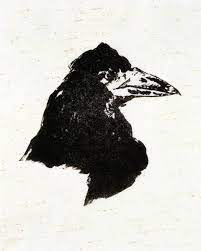
the poet didn't just use language in his translation: Mallarmé’s 1875 edition
of "Le Corbeau" is made even more enchanting by the illustrations
adorning the text. The shadowy black smudgings belong to none other than French
painter Édouard Manet. Mallarmé and Manet had been friends for years (according
to the Musée d'Orsay, they would meet every day to discuss painting,
literature, and cats), and Mallarmé would write an impassioned article that
would proclaim Manet’s influence “sways all the
painters of the day.”
Mallarmé called the
illustrations “so intense and at the same time so modern ... completely
imaginative in their reality.
So
it was not only an interlingual translation but also an equally atmospheric
intersemiotic one. Manet’s visualisation of the raven, which can be seen at the
head of this post, is haunting.
In
addition, there is a secondary atmosphere in what is a complex poem. It is
heralded by the opening words, Once upon a…, the typical opening of fairy
stories in their mythical settings, partly echoed by Mallarmé’s Une fois derived
from Il était une fois. It continues throughout, for instance in Poe's constant use
of chamber instead of the modern word room, which has an effect lost by the
French chambre. It’s a gothic atmosphere, in the sense of “a style of fiction characterized by the use of desolate or
remote settings and macabre, mysterious, or violent incidents.”
For
the rest, I’ll leave it to native French speakers to judge subjectively whether
Mallarmé, and for that matter Baudelaire, succeeds in preserving the melancholy atmosphere.
To sum up the three posts in this trilogy: Next
time you want to judge a literary translation, don’t start by nitpicking whether each chunk
accurately repeats the information in the original. Rather, ask yourself, “Does the whole express convincingly its emotions? Does it do so with the same forcefulness?
Does it maintain the same atmosphere?”
Sources
Edgar Poe [sic]. Le Corbeau. Translated by Stéphane Mallarmé with
illustrations by Édouard Manet. Paris: Lesclide, 1875.
Edgar Poe.
Le Corbeau. Translated by Charles Baudelaire. In Histoires grotesques
et sérieuses, Paris, 1865.
Poe, Edgar A. The Philosophy of Composition. Graham’s Magazine,1846.
Siavish
Bakhtiar. Charles Baudelaire et Stéphane Mallarmé, traducteurs d’Edgar Allan
Poe. Available from: https://www.researchgate.net/publication/338633376_Charles_Baudelaire_et_Stephane_Mallarme_traducteurs_d'Edgar_Allan_Poe.
Jared Spears. How Poe's French translator made "The Raven" even spookier. Mental Floss, 2018. https://www.mentalfloss.com/article/87072/how-poes-french-translator-made-raven-even-spookier.
Dante Allighieri. The Comedy of Dante Allighieri
... Translated into blank verse by William Michael Rossetti, with introductions and notes. London
; Cambridge : Macmillan, 1865.
Gothic. Merriam-Webster.com Dictionary,
Merriam-Webster, 2022. https://www.merriam-webster.com/dictionary/Gothic.